

 English
As edge AI moves from experimentation to real-world deployment, memory bandwidth is becoming one of the most critical system bottlenecks. In many embedded AI inference applications, the processor itself is not the primary limitation—the memory interface is. Edge processors require significantly higher bandwidth to handle growing AI workloads, yet they must still operate within tight constraints on power consumption, board space, thermal design, and overall system cost.
Once the interface reaches its throughput limit, adding more compute capability delivers limited system-level gains. Expanding bandwidth through wider interfaces increases pin count, routing complexity, and package size, while pushing higher data rates raises switching losses and thermal load—tradeoffs that are especially challenging in edge devices with limited design margins.
Reducing the distance between memory and processor can improve transfer efficiency, but conventional stacking approaches often introduce new challenges. Thermal dissipation becomes more difficult, routing density increases, and performance constraints may simply shift rather than disappear under sustained AI workloads.
This widening gap between AI compute demand and memory capability is where Winbond sees a key opportunity for its CUBE architecture.
CUBE enabling higher data throughput
CUBE (Customized Ultra-Bandwidth Elements) is an advanced memory architecture developed to provide a compact, efficient, and high-bandwidth solution for emerging edge AI applications. It is designed to meet growing data throughput demands without relying on the larger, more power-intensive memory approaches commonly used in datacenter systems.
The architecture supports both Chip-on-Wafer (CoW) and Wafer-on-Wafer (WoW) front-end integration and is compatible with back-end 3D advanced packaging technologies, including Cap-interposer for enhanced power delivery performance. Winbond is also working closely with foundries, OSATs, and ASIC partners to build a broader ecosystem that supports next generation edge AI system integration.
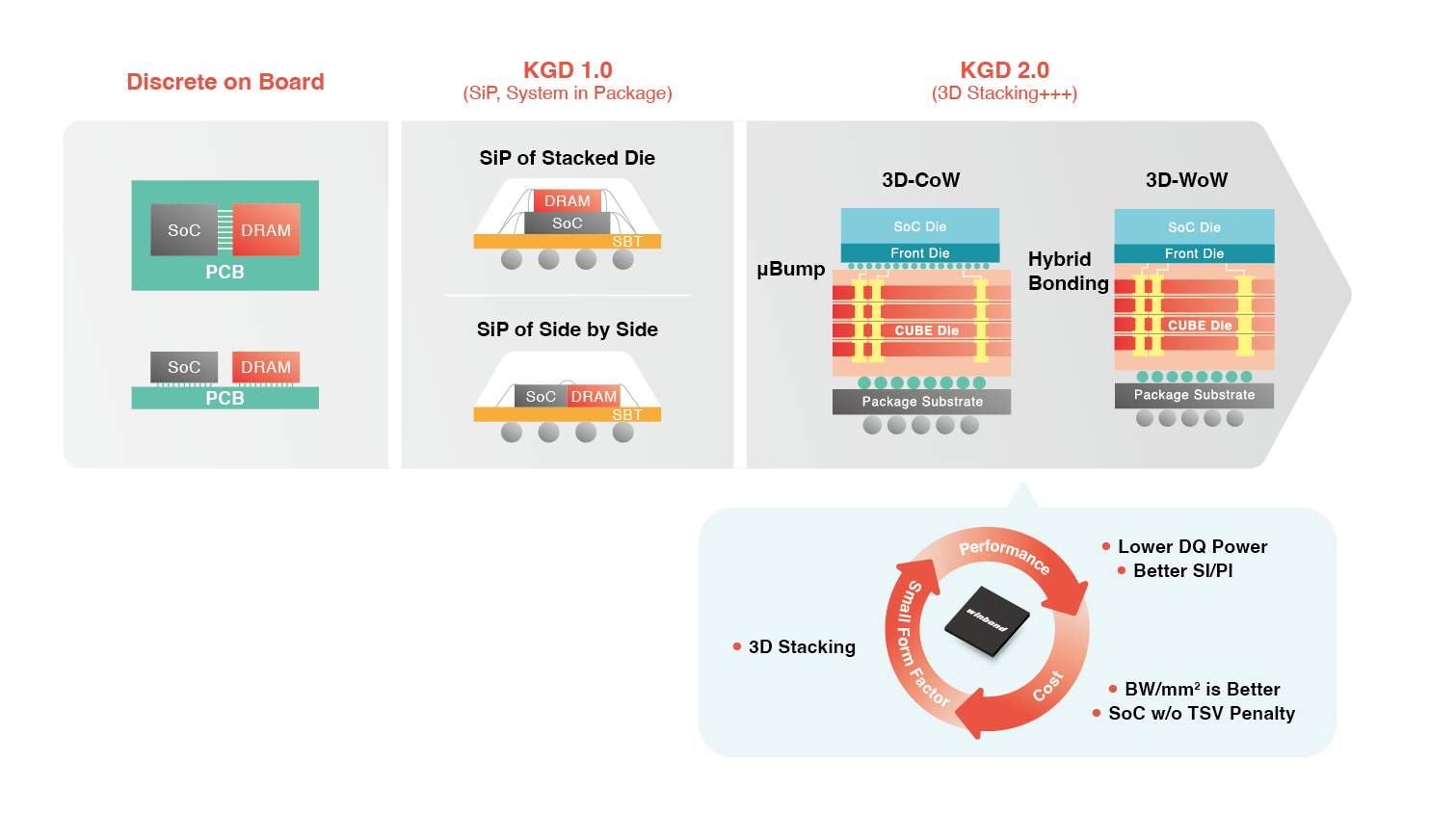
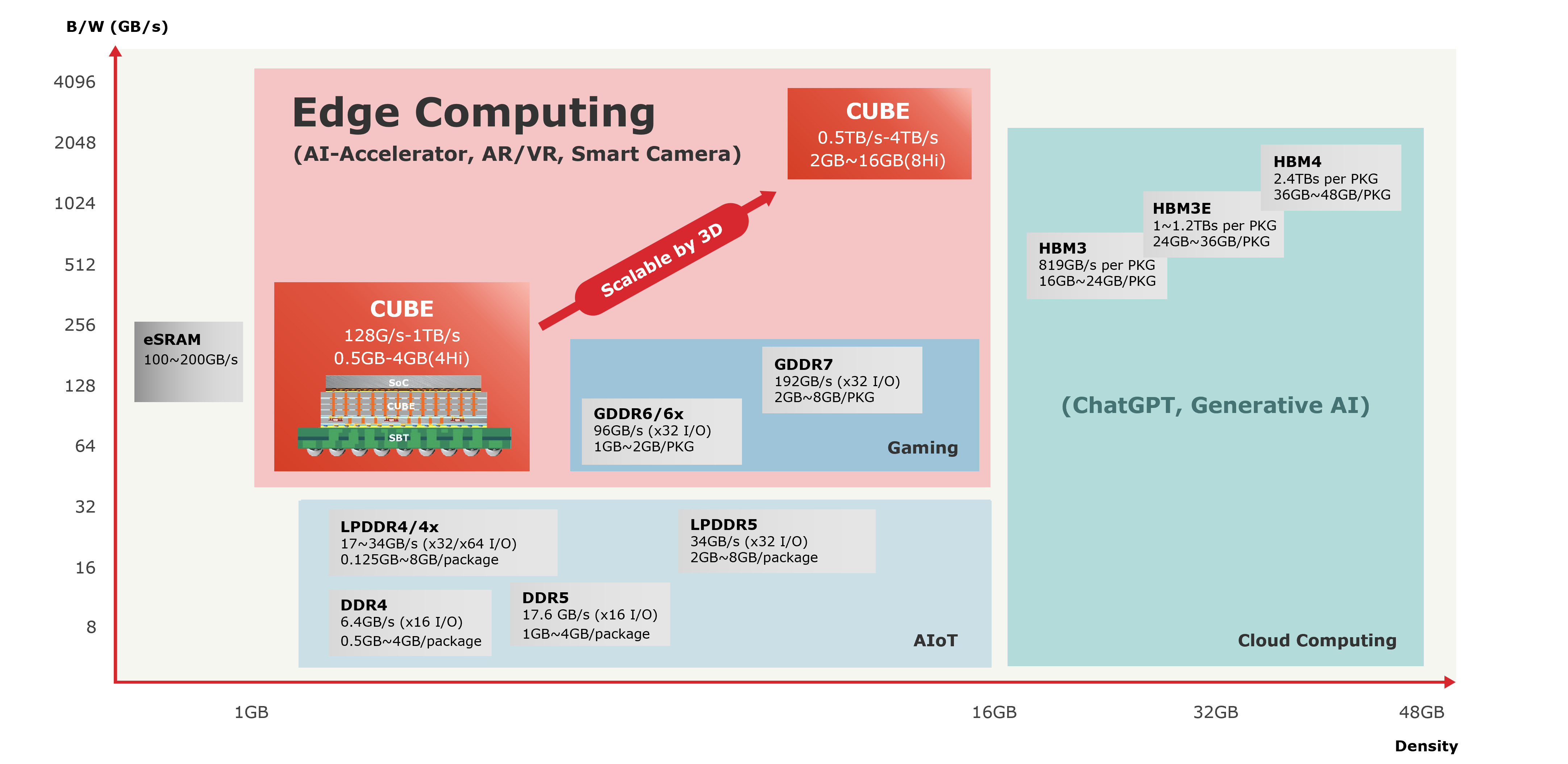
At the technical level, CUBE combines area-efficient TSV design with advanced die-to-die interconnect technologies such as μbump and hybrid bonding, enabling higher I/O density, faster data transfer, and improved thermal efficiency. It can deliver up to 256GB/s bandwidth per die, while a 4Hi stack can scale to 1TB/s, with energy efficiency below 1pJ/bit. This makes CUBE well suited for edge devices requiring sustained AI performance within strict power and thermal limits.
CUBE also offers flexible memory scaling, with densities ranging from 1GB to 2GB per die. A 4Hi configuration provides 4GB to 8GB total capacity, helping designers align memory resources with AI model size and workload requirements. Combined with model optimization technologies such as TurboQuant, CUBE can help enable more advanced local AI processing directly on edge devices.
Its compact footprint is another important advantage. By stacking the compute die directly above the memory, CUBE reduces overall board space compared with conventional discrete designs, making it ideal for applications such as AR/VR devices, drones, robotics, smart cameras, and other physical AI systems where performance, thermal control, and space efficiency are equally critical.
CUBE-Lite for lower-power implementations
Alongside CUBE, Winbond is also developing CUBE-Lite, extending the same edge AI vision to lower-power endpoint devices. While CUBE is designed for applications requiring ultra-high bandwidth, CUBE-Lite is optimized for TinyML and battery-powered AI SoCs, where low power consumption, simplified integration, and efficient on-device inference are prioritized over peak throughput. This makes CUBE-Lite well suited for wearables, AI glasses, smart cameras, and other always-on intelligent edge devices.
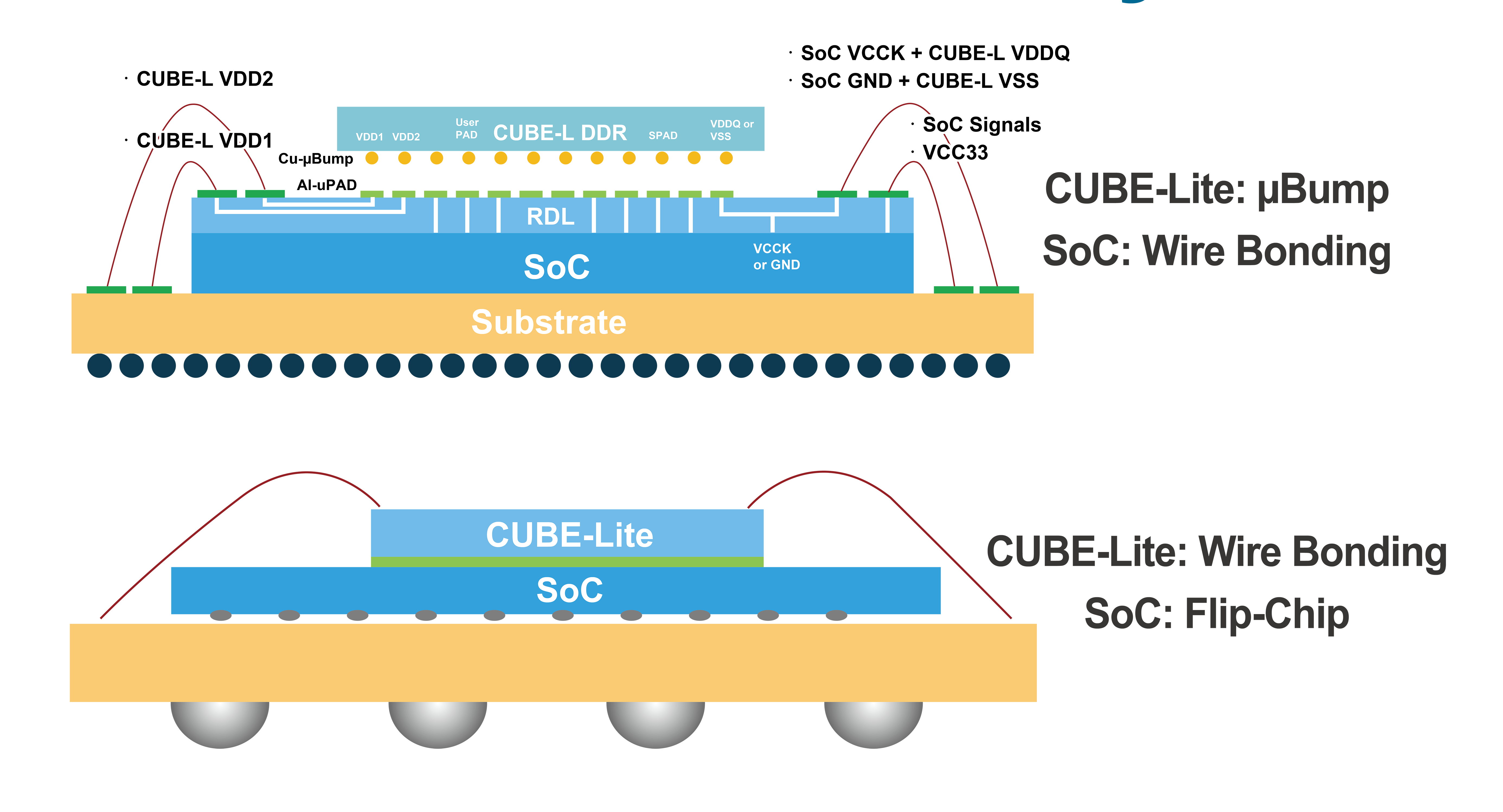
Together, CUBE and CUBE-Lite represent a broader memory strategy for edge AI: one platform tailored for bandwidth-intensive intelligent systems, and another designed for compact, power-sensitive endpoints. In both cases, the shared objective is clear—to enable practical, efficient, and local AI processing in real-world devices.
Secure Flash protects system integrity
System behaviour depends on the integrity of stored code and AI model data, particularly in devices deployed outside controlled environments where physical access cannot be prevented.
The TrustME® W77Q Secure Flash family provides hardware-based protection at the storage level and is compatible with the W25Q SPI NOR Flash footprint, allowing it to be introduced without changes to PCB layout or power design.
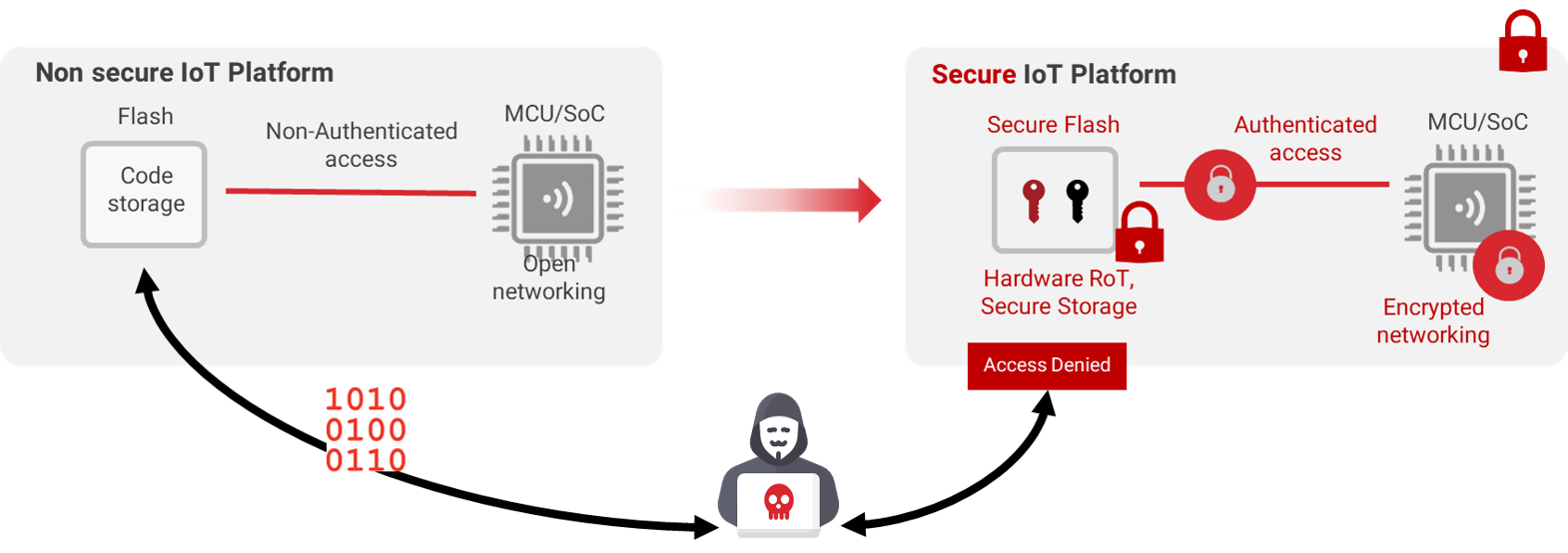
The devices support secure boot, root-of-trust validation, authenticated over-the-air updates and rollback protection, ensuring that only verified firmware and model data are executed and that updates cannot be used to introduce unauthorised changes. Support for LMS-OTS signatures provides a path towards post-quantum readiness, while alignment with Common Criteria EAL2+, SESIP Level 2 and ISO 21434, along with FIPS 140-3 (CAVP) in progress, reflects compliance with current security requirements.
Interface behaviour remains consistent with standard SPI NOR Flash, supporting SPI through QPI modes at up to 166MHz.
Combining performance and integrity
These solve different problems in AI edge systems. Increasing bandwidth without protecting stored code introduces risk, while securing the system without addressing data movement limits restricts AI performance. CUBE supports higher throughput where the interface is the constraint, CUBE-Lite supports designs where power and integration limits dominate, and W77Q ensures that the system starts and runs from a verified state.
Conclusion
Performance in AI edge systems is constrained by how data moves and whether the system can be trusted.
Increasing bandwidth alone does not fix the problem, since power, thermal behaviour and firmware integrity all limit what AI workloads can sustain and do not fail independently. CUBE increases available throughput when the interface is the constraint; CUBE-Lite applies the same approach when power and integration limits dominate; and W77Q ensures that the system starts and runs from a verified state.
Taken together, they allow AI edge systems to scale without simply moving the limitation somewhere else.Bottom of Form
Technical Articles
-

Closing the security gap left by conventional NOR Flash ICs
-
Check connection between SOC and DRAM with IC Boundary Scan Technology
-

How efficient memory solutions can help designers of IoT nodes meet tight BoM cost targets
-

New lower-cost memory solution for 5G cellular modems helps drive adoption of ultra-fast wireless broadband
-

QspiNAND with ultra-fast write speed: A new option for over-the-air updating of automotive code
-

The keys to successful adoption of new low-voltage memory ICs
-

Three mega-trends for a post-Covid world, and how they affect users of memory technology
-
What You Need to Know about HyperRAM™ – An Alternative Memory Option
-

The New Role of Storage Manufacturers in the Metaverse
-

Choosing the Right Flash Memory for AI Endpoint Applications
-

How Serial Flash technology is evolving to meet the new requirements of Industry 4.0 designs
-
New generation of wearable medical devices calls for secure, high-density non-volatile memory