

 English
For many years, automotive manufacturers have been able to rely on memory suppliers to support long production lifecycles and respond quickly to changing requirements. However, exploding demand for AI infrastructure is changing those expectations and creating new challenges for companies planning future vehicle platforms.
As data center operators continue to invest heavily in new AI servers, demand from this sector is driving development trends throughout the semiconductor industry and influencing how memory suppliers allocate production capacity. While automotive remains an important market, memory vendors are increasingly balancing its requirements against demand from AI applications that consume large volumes of memory and represent large commercial opportunities.
At the same time, vehicle electronics continue to become more sophisticated. Advancing ADAS, software-defined vehicle (SDV) architectures and higher levels of automation all increase memory requirements. Automotive manufacturers therefore face a situation where demand for memory is rising inside the vehicle while competition for memory technologies is increasing outside it.

Why Are Automotive Supply Chains Feeling the Impact of AI Demand?
At first glance, AI servers and passenger vehicles appear to have little in common. One operates inside a data center, while the other operates on the road. The connection becomes clear when both depend on the same semiconductor supply chain.
Traditionally, semiconductor suppliers have viewed automotive market as a strategically important market segment because of its steadily increasing volume demand, exacting qualification requirements, and long product lifecycles. Vehicle manufacturers expect components for any given platform to remain available throughout its production lifetime and typically require support to extend for an appreciable period thereafter.
AI infrastructure has introduced a different commercial dynamics.
An AI server may contain significantly more semiconductor content than an automotive electronic control unit. Demand growth coming from this sector has also been very rapid. For memory manufacturers, there are strong incentives to push investment and production towards products supporting AI infrastructure.
The impact is becoming visible across the supply chain. Lead times for several memory categories have extended and suppliers are reviewing product strategies to align with changing market requirements. Many industry observers have drawn comparisons with the supply constraints experienced following the COVID-19 pandemic. Whether conditions reach the same level remains uncertain, but the pressure on memory supply is attracting increasing attention throughout the automotive sector.
The greater concern for automotive manufacturers is not necessarily cost. It is availability.
If a selected memory device becomes difficult to source, replacing it can be a lengthy process. Alternative components must be qualified before they can be introduced into production. Software compatibility must be verified and validation activities repeated. What begins as a component shortage can ultimately affect programme schedules years after the original disruption occurs.
Long-term availability has therefore become a design consideration rather than simply a procurement issue.
Supply Pressures Have Not Slowed Vehicle Development
Supply chain concerns have emerged during a period of significant change for the automotive industry. Economic pressures in China, changes in government incentives and increasing competition between manufacturers have created uncertainty across parts of the market. As vehicle manufacturers are facing greater commercial pressure than in previous years, suppliers are being asked to respond to rapidly changing forecasts.
Despite these challenges, development activity continues. Manufacturers are introducing increasingly capable driver assistance systems. With software content expanding, connected services are becoming more common across multiple vehicle segments – and each development increases demand for memory.
The automotive market is therefore experiencing two pressures simultaneously. Memory requirements continue to grow while supply planning becomes more complex.
Software-Defined Vehicles Are Changing Memory Requirements
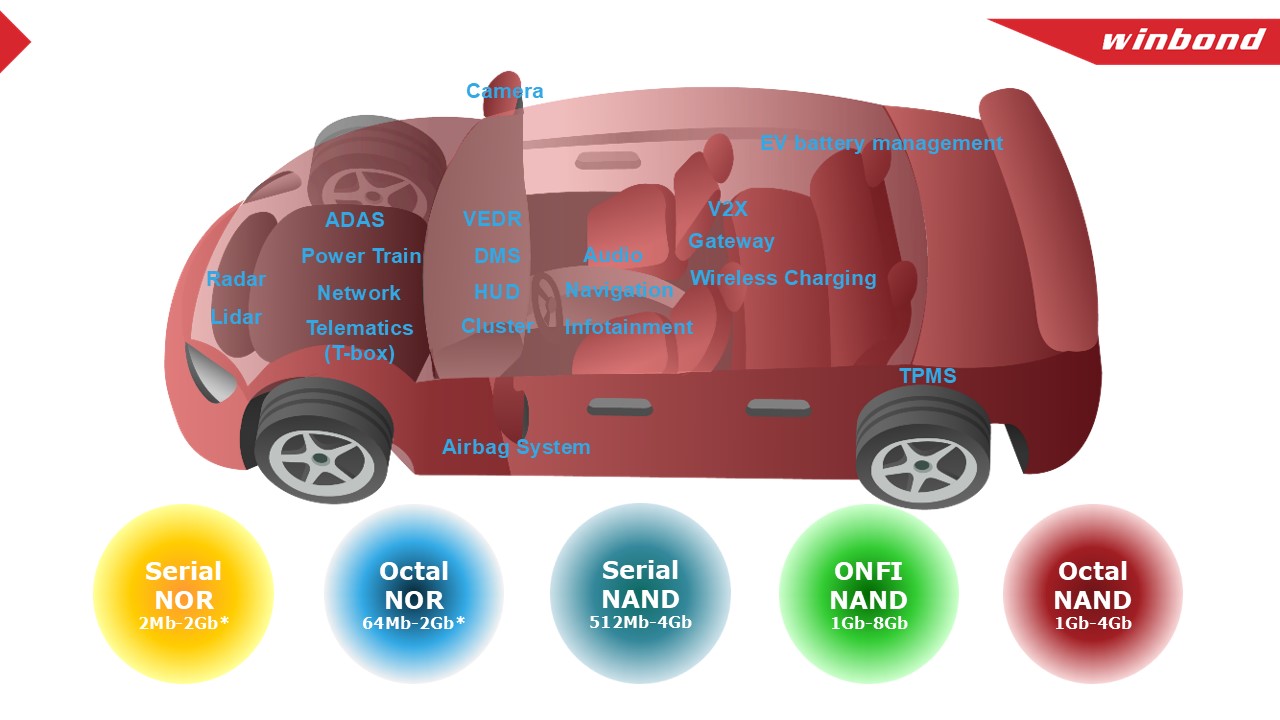
Software-defined vehicles have become one of the most significant developments in automotive electronics. Historically, the electronics content has varied according to factory-fitted features and any options selected by the original purchaser. Software-defined architectures are changing that model by requiring the hardware platform to support functions that may be enabled later through software updates. This creates advantages for manufacturers and consumers alike. Features can be activated after purchase, software can be updated remotely, and new services can be introduced throughout the vehicle lifecycle. It also changes memory requirements.
Every vehicle platform must be capable of supporting software functions that are to be enabled immediately as well as those that may be activated later. As software content changes, Flash memory must store larger software images while delivering the performance needed for fast system start-up. Consumers expect a vehicle to respond immediately as soon as they push the start button. Behind that expectation now sits an increasingly complex software environment that must be loaded quickly and reliably. The result is driving demand for greater memory density as well as faster performance.
More Capable ADAS Functions Require More Memory
Memory demand is also increasing as vehicles move towards higher levels of automation. Level 2 driver assistance systems are now common across many vehicle categories. The progression towards L2+, L3, and beyond requires more sophisticated processing and access to larger volumes of data. Vision systems continue to add more cameras with greater image resolution. Sensor fusion platforms process more channels and richer information than previous generations. Advanced algorithms require larger software environments and additional memory resources.
This affects multiple areas of the memory subsystem. Code storage memory must accommodate larger software code base. Working memory requirements increase as computing platforms handle more complex workloads. Performance expectations continue to rise as vehicle systems become more capable. Memory density has grown significantly over recent years and suppliers are expecting this trend to continue as automotive applications become more demanding.
Does Every AI Application Depend on Leading-Edge Technology?
Discussion surrounding AI often focuses on advanced process nodes and high-performance data centre infrastructure. That attention can create the impression that every AI application depends on the latest semiconductor technology.
The reality is more diverse. Many AI applications operate at the edge, where power consumption, reliability and cost are often more important than maximum performance. These systems frequently utilise mature process technologies that have proven themselves across a wide range of applications. Automotive electronics follow a similar pattern.
Some vehicle systems require substantial computing capability. Others prioritize reliability and long-term availability. Selecting the right technology depends on the task being performed rather than pursuing the most advanced process node in every application. This diversity helps support a broader semiconductor ecosystem and reduces dependence on any single technology approach.
Planning Ahead Is Becoming More Important
One of the strongest messages emerging from today's memory market is that traditional supply assumptions are changing. Automotive manufacturers have historically relied on highly responsive supply chains and just-in-time delivery models. That approach becomes more challenging when suppliers are committing capacity to support long-term demand from rapidly expanding markets such as AI infrastructure.
For automotive manufacturers and Tier 1 suppliers, planning further ahead is becoming increasingly important. Understanding supplier roadmaps earlier in the design cycle provides greater visibility into future product availability. Close engagement with component manufacturers helps identify potential risks before they affect production programmes. Making these changes can create more flexibility as market conditions change.
The rapid and unrelenting expansion of the AI server market presents challenges for the automotive sector, but it is also driving investment across the semiconductor industry. New manufacturing capacity, improved memory technologies and continued product development will ultimately benefit multiple markets.
The immediate challenge is managing the transition. Automotive electronics will continue to demand greater memory density and higher levels of performance. Being able to meet those requirements successfully will depend not only on selecting the right technology, but also on understanding how changing market dynamics can affect availability throughout the lifetime of a vehicle platform.
Technical Articles
-

Closing the security gap left by conventional NOR Flash ICs
-

Check connection between SOC and DRAM with IC Boundary Scan Technology
-

How efficient memory solutions can help designers of IoT nodes meet tight BoM cost targets
-

New lower-cost memory solution for 5G cellular modems helps drive adoption of ultra-fast wireless broadband
-

QspiNAND with ultra-fast write speed: A new option for over-the-air updating of automotive code
-

The keys to successful adoption of new low-voltage memory ICs
-

Three mega-trends for a post-Covid world, and how they affect users of memory technology
-

What You Need to Know about HyperRAM™ – An Alternative Memory Option
-

The New Role of Storage Manufacturers in the Metaverse
-

Choosing the Right Flash Memory for AI Endpoint Applications
-
How Serial Flash technology is evolving to meet the new requirements of Industry 4.0 designs
-

New generation of wearable medical devices calls for secure, high-density non-volatile memory